


If your goal is fat loss and building muscle, does it really matter what kind of exercise you do? Absolutely. You can work hard, sweat a lot, and feel exhausted after a workout without doing much to build muscle, get stronger, or change your body composition. The best exercise for fat loss and building muscle isn’t necessarily the workout that feels the hardest. It’s the type of training that gives your body a reason to adapt—and continues to give it a new reason to adapt as you get stronger.
In this video, Chris Rombola breaks down several popular forms of exercise and ranks them based on one specific question: How effective are they for someone who wants to lose fat, build or maintain muscle, get stronger, and change the way their body looks?
What Makes Exercise Effective for Fat Loss and Building Muscle?
Before ranking different types of exercise, it’s important to establish the standard we’re using.
We’re not ranking what’s the most fun.
We’re not ranking what’s best for balance.
We’re not ranking the best sport.
We’re asking which type of training is most effective for the average person whose goals include:
- Losing body fat
- Building or maintaining muscle
- Getting stronger
- Improving body composition
- Changing the way their body looks
To build muscle and strength, your body needs a reason to adapt. That requires enough resistance, enough effort, and—perhaps most importantly—progression over time.
As your body adapts to a particular training stimulus, the demands need to increase.
That’s the principle of progressive overload, and it’s one of the foundations of effective strength training.
1. Pilates, Barre and Balance Work
Rating: 1/10 for these specific goals
Let’s start with Pilates, barre, balance work, and exercises that are often described as “working your stabilizer muscles.”
Can Pilates be difficult? Absolutely.
But difficulty by itself doesn’t make an exercise effective for building muscle or strength.
Imagine doing biceps curls while standing on a Bosu ball. It would probably be much harder than doing biceps curls while standing on solid ground.
But if your goal is to make your biceps stronger, making the exercise harder by challenging your balance doesn’t necessarily make your biceps work harder. In fact, you may have to reduce the amount of force your biceps can produce because you’re also trying not to fall over.
That’s an important distinction: an exercise can feel harder without providing a better stimulus for the muscle you’re trying to develop.
What About “Stabilizer Muscles”?
The phrase “working your stabilizers” gets used frequently in the fitness industry.
But muscles that stabilize your body are still muscles. They have specific names and functions, and there are specific exercises we can use to make them stronger.
Rather than treating “stabilizers” as a mysterious category of muscles, good strength training identifies what actually needs to become stronger and chooses an appropriate exercise to train it.
Pilates Doesn’t Lengthen Your Muscles
Another common claim is that Pilates or barre can turn short, bulky muscles into long, lean muscles.
That’s not how muscle works.
You don’t exercise a muscle in a particular way and physically lengthen it into a different shape. Your muscle structure, genetics, bone structure, body composition, and the amount of muscle and fat you carry all contribute to how your physique looks.
It’s also important not to confuse the body someone brought to an activity with the body that activity created.
The instructor at the front of a Pilates or barre class may already have the body type you associate with that activity. That doesn’t mean Pilates created that physique.
The same principle applies to dancers and other athletes. Certain activities can select for particular body types, especially at higher levels of competition.
Is Pilates Bad?
No.
Pilates can have value for someone who is completely untrained, learning to control their body, returning from an injury, or simply looking for an activity they enjoy.
And if you love Pilates or barre, there’s absolutely nothing wrong with doing it.
But if the specific goal is systematically building muscle and strength and changing body composition, it isn’t the most effective tool for that job.
2. Boot Camps
Rating: 2.5/10 for these specific goals
Boot camps rank a little higher because you’re typically moving, using resistance, and working hard.
They’re also excellent for conditioning.
But there’s an important problem: being exhausted isn’t the same thing as progressive overload.
You might move from kettlebells to battle ropes to push-ups to jumping and then immediately run to the next station. You’re sweating, your heart rate is elevated, and you’re exhausted at the end.
Those are real experiences, but they don’t automatically mean you’re building more muscle.
A beginner may build some muscle doing a boot camp because almost any new resistance stimulus can produce an adaptation initially.
But as you become accustomed to the workouts, you may primarily become better at doing the workout.
You move through the stations more efficiently.
You don’t get as tired.
Your conditioning improves.
Those are legitimate adaptations. But they aren’t necessarily the same as systematically getting stronger and building more muscle.
Burning Calories Isn’t the Same as Building Muscle
Exercise burns calories, and that’s useful.
But burning calories during a workout isn’t the same thing as building the muscle you want to maintain for the other 23 hours of the day.
If your goal is to change your body composition, you need to think beyond how many calories you burned during the workout.
The training stimulus matters.
3. Random Gym Lifting
Rating: 6/10
Now we’re getting somewhere.
If you go to the gym and do three sets of ten on a few machines, some curls, and some leg exercises, you’re doing real resistance training.
You’ll probably build some muscle.
You’ll probably get stronger.
But there’s a problem: there’s no roadmap.
You’re exercising, but you’re not necessarily training.
Ask yourself this:
If six months from now you’re using basically the same weights, doing basically the same reps, and basically look the same, what exactly did you ask your body to adapt to?
You can’t simply repeat the same workout indefinitely and expect your body to continue changing.
Eventually, you get stuck.
The Difference Between Exercise and Training
This is where programming matters.
A well-designed strength training program may change exercises, volume, intensity, frequency, and recovery over time.
Those changes give your body a new reason to adapt.
That’s the difference between simply showing up at the gym and following a plan designed to take you somewhere.
Random lifting can get you somewhere. Programming tells you where to go next.
4. CrossFit
Rating: 6/10
CrossFit trains a lot of physical qualities: strength, power, endurance, conditioning, gymnastics, and skill.
And there’s nothing inherently wrong with that.
But one important thing to understand is that CrossFit is a sport.
When you attend a CrossFit class, you’re primarily training to get better at CrossFit.
Can CrossFit make you stronger? Absolutely.
Can it improve your fitness? Absolutely.
Can you build muscle doing it? Certainly.
But if your specific goal is to systematically build muscle, maintain muscle while losing fat, and change your body composition, there are more direct ways to train for those adaptations.
Interestingly, look at elite CrossFit athletes and you’ll see that many aren’t simply taking CrossFit classes. They also perform dedicated strength training, accessory work, skill work, and conditioning to develop the individual physical qualities they need.
In other words, they’re doing many of the things that structured strength and hypertrophy programs are designed to accomplish—and then applying those abilities to their sport.
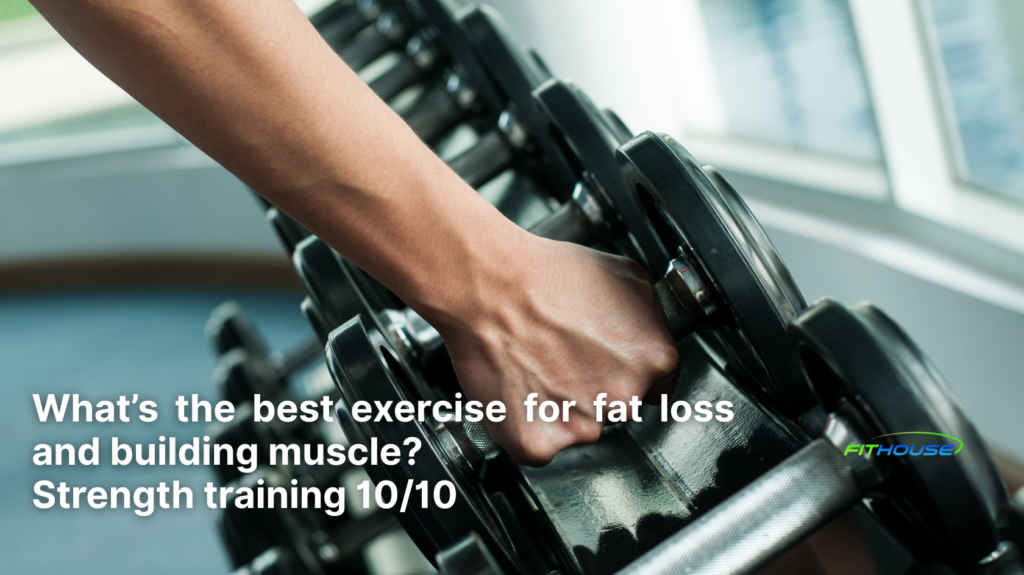
5. Properly Designed Strength and Hypertrophy Training
Rating: 10/10
If the goal is to build or maintain muscle, get stronger, and change body composition, this is where structured strength training shines. It is the best exercise for fat loss and building muscle.
A properly designed strength and hypertrophy program should:
- Train the entire body
- Use exercises appropriate for the individual
- Track what you’re doing
- Provide enough resistance and effort
- Progress over time
- Address weaknesses or muscle groups that need additional attention
- Adjust the program as your body adapts
That’s progressive overload in practice.
Instead of randomly choosing exercises and hoping you get stronger, you’re deliberately creating a training stimulus and then increasing the demands as your body becomes capable of handling more.
What Can Bodybuilding Teach Us About Changing Your Body?
Here’s another way to think about it:
Success leaves clues.
What if there were an entire sport built around developing muscle and getting as lean as possible?
There is.
For women, figure and physique competitors provide an example. For men, bodybuilding does the same.
That doesn’t mean the average person who wants to lose 50 pounds needs to become a bodybuilder or step onstage.
But the fundamental process is similar.
Someone preparing for a physique competition is trying to reduce body fat while maintaining—or potentially building—muscle.
Someone who wants to lose 50 pounds may have the same basic goal.
The difference is the destination.
One person stops when she reaches the physique and level of leanness she wants. The competitor continues toward a stage-ready physique.
Same road. Different destination.
And how do these people train?
They strength train.
They track their training.
They program their training.
They progressively increase the demands placed on their bodies.
Why Strength Training Matters During Weight Loss
This is one of the most important reasons strength training is the best exercise for fat loss and building muscle.
When you create a calorie deficit, your body loses weight.
But that weight doesn’t automatically come exclusively from body fat.
Without appropriate resistance training, weight loss can include both fat and muscle.
And that’s not necessarily the outcome you want.
If your goal is to look leaner, stronger, and more capable, simply becoming smaller isn’t enough.
You want to lose fat while maintaining as much muscle as possible—and ideally build muscle when circumstances allow.
That’s where strength training becomes especially important.
Think of it this way:
The calorie deficit tells your body to lose weight.
Strength training tells your body to keep the muscle.
That combination is a much better strategy for improving body composition than simply eating less and doing more exercise.
Why Muscle Matters
Your body uses energy around the clock to keep you alive. Your brain, heart, liver, kidneys, organs, and tissues all require energy.
Your basal metabolic rate is influenced by many things, including your age, genetics, sex, organs, and body composition.
You can’t change your genetics.
You can’t turn back the clock.
And you can’t put your liver on a progressive strength training program.
But you can deliberately influence your amount of muscle through resistance training.
That’s one reason preserving muscle during weight loss matters.
If you lose weight without maintaining your muscle, you can become smaller while also having less metabolically active tissue.
That’s not the direction we want to take your body composition.
We want to lose the fat, maintain the muscle, and, when possible, build more muscle.
So What’s the Best Exercise for Fat Loss and Building Muscle?
There’s no requirement that you give up every activity you enjoy.
If you love running, run.
If you love Pilates, do Pilates.
If you enjoy CrossFit, do CrossFit.
If you love boot camps, keep doing them.
Enjoyment matters, and there are many legitimate reasons to exercise beyond changing your physique.
But if your primary goal is fat loss, building or maintaining muscle, getting stronger, and changing your body composition, it’s worth asking whether the training you’re doing is actually designed to produce those adaptations.
That’s the question behind this entire ranking.
Because there’s nothing worse than working incredibly hard, staying consistent, and eventually concluding that your body simply “doesn’t respond.”
Maybe your effort wasn’t the problem.
Maybe the program was.
The goal isn’t to make you work harder just for the sake of working harder.
The goal is to take the effort you’re already willing to give and point it toward training that is designed to get you where you want to go.
The Bottom Line
The best exercise for fat loss and building muscle isn’t necessarily the exercise that leaves you the most exhausted.
It’s the training that provides an appropriate stimulus, gives your body a reason to adapt, and progresses as you become stronger.
For someone whose primary goals are improving strength, building or maintaining muscle, and changing body composition, that means properly programmed strength and hypertrophy training should be the foundation.
You don’t have to work harder.
You may simply need to train with more direction.
Want help getting stronger and changing your body without wasting your effort?
At Fit House, we use structured small-group strength training to help adults build strength, maintain muscle, and improve body composition through progressive, sustainable training.
Find out how to train with us here.
About the author
Chris Rombola
Chris is the owner of Fit House. He's run the training departments at several commercial gyms, and after years of seeing how awful those environments were for his clients, he opened his own studio. He is devoted to getting people strong, lean, and healthy.